024 · Haiku
°
The poetic form now called haiku developed from the hokku, the opening verse of linked forms such as renga and haikai no renga. Matsuo Bashō (1644–1694), now best known for haiku, was first and foremost a master of haikai, a communal practice of linked verse. His hokku belonged to that collaborative practice, even when they could stand as poems in their own right. In the late nineteenth century, Masaoka Shiki (1867–1902) denounced linked verse and recast haiku as an individual poetic form.1
Bashō also wrote haibun, a form that brings prose into relation with hokku. Narrow Road to the Interior is an extended example.2 Prose and verse alter one another. Each disturbs or redirects what came before.
Kobayashi Issa (1763–1827) pursued the autobiographical possibilities of haibun in The Spring of My Life.3 In haiga, haikai verse enters into relation with painting and calligraphy. Sparse imagery, calligraphy and verse act upon one another.4
In my view, a related coupling of image and text appears in the critical and personal works of the French literary theorist Roland Barthes, with photographs in place of ink paintings. He refers directly to Japanese poetics in Empire of Signs and Camera Lucida.5 Haiga and haibun provide names for structures he leaves unnamed in the latter. I read both forms at work there.
Throughout Camera Lucida, Barthes places photographs beside brief passages of his own prose. In my own work, I use photographs more sparingly. Sometimes I pair one with a haiga-inflected, Barthesian caption to draw out subtext, add context or inject a thought. Elsewhere, I leave the image alone. The reader’s gaze remains on the visual. Text waits at the periphery.
On page 58 of Camera Lucida, Barthes’s words direct Robert Mapplethorpe’s Young Man with Arm Extended and extend its narrative.6 The excerpt beneath the photograph forms a stylistic wedge. It ‘hijacks’7 the image from the neutrality of its attribution and returns it to Barthes’s prose.
How much of this wedge belongs to concept, and how much to the ordinary demands of attribution? Was it Barthes’s intention from the start? Did the page discover itself during typesetting? Or did I discover it through reading?
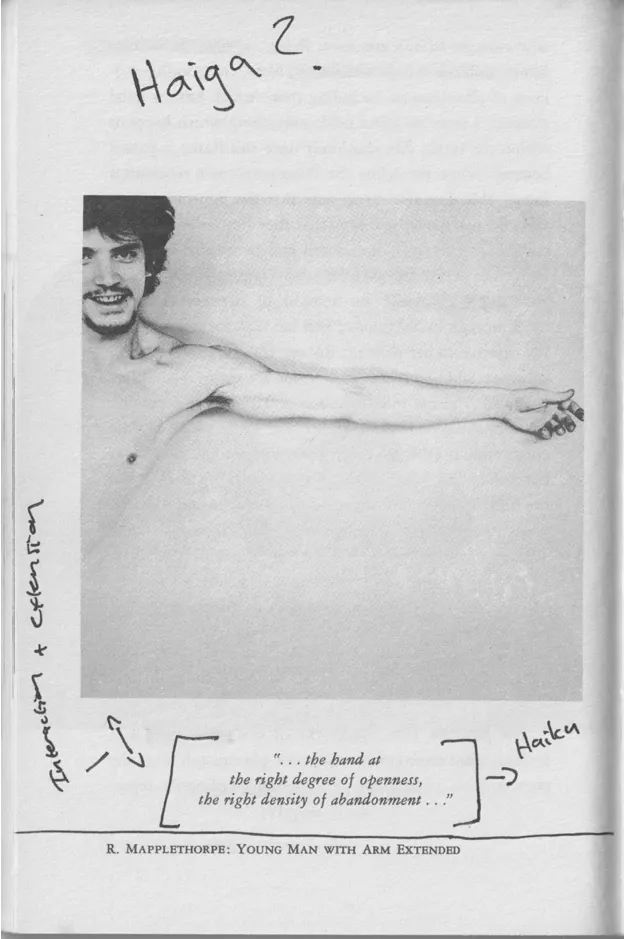
In my copy, I drew a horizontal line above the attribution. The printed page already separates the two textual registers through type. The attribution appears in uppercase roman lettering and carries the formality of a label. Barthes’s words appear in lowercase italics, enclosed by ellipses. They carry a voice still in motion. Barthes speaks through the photograph.
The page does something stranger than caption the image.
The italicised words are a fragment of a sentence that has not yet arrived.
On the following page, Barthes returns to the hand. A few millimetres more or less would alter the body’s offer. The exact openness of the hand becomes evidence of the photographer’s luck. Mapplethorpe has found the ‘right moment, the kairos of desire’.8
The printed excerpt withholds that explanation. It divides the phrase across three lines, surrounds it with ellipses and places it above the formal attribution. Prose becomes a small poem. The phrase reaches the reader first as an image, then as an argument.
The photograph catches the right moment.
The page catches the phrase.
The caption’s three lines contain three, five and five words. They depart from the familiar 5–7–5 model. Their haikuity lies in temporal severance, motion, brevity, and a recognition of what precedes and follows the cut.
The photograph crops the body.
The caption crops the sentence.
The page makes a case for contemporary photographic haiga.
In Empire of Signs, Barthes writes:
The text does not “gloss” the images, which do not “illustrate” the text.9
The text brings something new to the image.
The image brings something new to the text.
A semiotic equation might be:
Meaning(Text + Image) > Meaning(Text) + Meaning(Image)
The greater-than sign proposes that the meaning produced by text and image in interaction exceeds the meanings each produces alone.10
Full-page photographic plates recur throughout Camera Lucida. Read as haiga, these compositions help Barthes stage the punctum11 on the page.
The second half of Camera Lucida turns around the Winter Garden Photograph.12 Barthes describes its discovery as ‘a sudden awakening, outside of “likeness,” a satori in which words fail’.13
In my reading, the Winter Garden Photograph functions as a Lacanian objet petit a, the object-cause around which desire continues to move.14 A Žižekian reading gives the absent photograph a sublime function within Barthes’s account of loss.15 The photograph becomes a promise of recovery fixed to an absence.
Barthes discusses the photograph at length and withholds it from the reader. Its absence is structural. I read his narrative around it as haibun, with the unseen photograph occupying the place of haiku. Bruce Ross describes haibun as a ‘narrative of an epiphany’. Haiku ‘offers us an epiphany’.16
The hidden object drives the text.
In moments of satori, I come as close as possible to it.
Then it relocates itself.
Haruo Shirane, ‘Beyond the Haiku Moment: Bashō, Buson, and Modern Haiku Myths’, Modern Haiku, 31.1 (Winter–Spring 2000), pp. 48–63, full text [accessed 24 July 2026]. See also Monkey’s Raincoat: Sarumino: Linked Poetry of the Basho School with Haiku Selections, trans. by Lenore Mayhew (Rutland, VT and Tokyo: Charles E. Tuttle, 1985), pp. 11–17, open PDF [accessed 24 July 2026].↩
Matsuo Bashō, Narrow Road to the Interior and Other Writings, trans. by Sam Hamill, 2nd edn (Boston: Shambhala, 2000). See also Michael Guest, ‘Bashō’s Narrow Road: Two Works by Matsuo Bashō’, Education About Asia, Association for Asian Studies, full text [accessed 24 July 2026].↩
Kobayashi Issa, The Spring of My Life and Selected Haiku, trans. by Sam Hamill (Boston: Shambhala, 1997). The publisher describes the work as an autobiographical composition of linked prose and haiku. See the Google Books record and description [accessed 24 July 2026].↩
Jim Kacian, ‘Looking and Seeing: How Haiga Works’, Contemporary Haibun Online, 18.1 (April 2022), full text [accessed 24 July 2026]. See also ‘The Haiga: Haiku, Calligraphy, and Painting’, Academy of American Poets, 21 February 2014, full text [accessed 24 July 2026].↩
Roland Barthes, Empire of Signs, trans. by Richard Howard (New York: Hill and Wang, 1982), p. xi. Roland Barthes, Camera Lucida: Reflections on Photography, trans. by Richard Howard (London: Vintage, 2000), pp. 49 and 109.↩
Barthes, Camera Lucida, p. 58.↩
I use ‘hijack’ here to signify creative play. The word retains a residue of force because the act shifts authority over the image.↩
Barthes, Camera Lucida, p. 59.↩
Barthes, Empire of Signs, p. xi.↩
The notation here is conceptual. Signification cannot be measured.↩
Barthes uses punctum to describe the accident or detail in a photograph that unexpectedly ‘pricks’ or wounds the individual viewer, disturbing the broader field of cultural interest he calls the studium. Barthes, Camera Lucida, pp. 26–27.↩
The Winter Garden Photograph is an 1898 image of Barthes’s mother, aged five, standing beside her seven-year-old brother in a glassed-in conservatory at her childhood home. Barthes discovered it while sorting family photographs after her death and felt that it revealed the truth of her character. The photograph is described at length but never reproduced in Camera Lucida. Barthes, Camera Lucida, pp. 67–73.↩
Barthes, Camera Lucida, p. 109.↩
Jacques Lacan, The Seminar of Jacques Lacan, Book XI: The Four Fundamental Concepts of Psychoanalysis, ed. by Jacques-Alain Miller, trans. by Alan Sheridan (New York: W. W. Norton, 1998), pp. 168 and 242–43. Lacan identifies objet a as the cause of desire and distinguishes it from an ordinary object that desire seeks to possess. Desire and the drive circle around this object without consuming or resolving it.↩
This is my application of Žižek’s account of the sublime object, which occupies the empty place of the Thing and gives form to the failure of representation. See Slavoj Žižek, The Sublime Object of Ideology (London: Verso, 2008), pp. 230–34.↩
Bruce Ross, Venturing Upon Dizzy Heights: Lectures and Essays on Philosophy, Literature, and the Arts (New York: Peter Lang, 2008), p. 101.↩